 Stedge Sports is a manufacturer of custom sportswear and apparel.

How to Design Your Own Cheerleading Uniform (Step-by-Step)

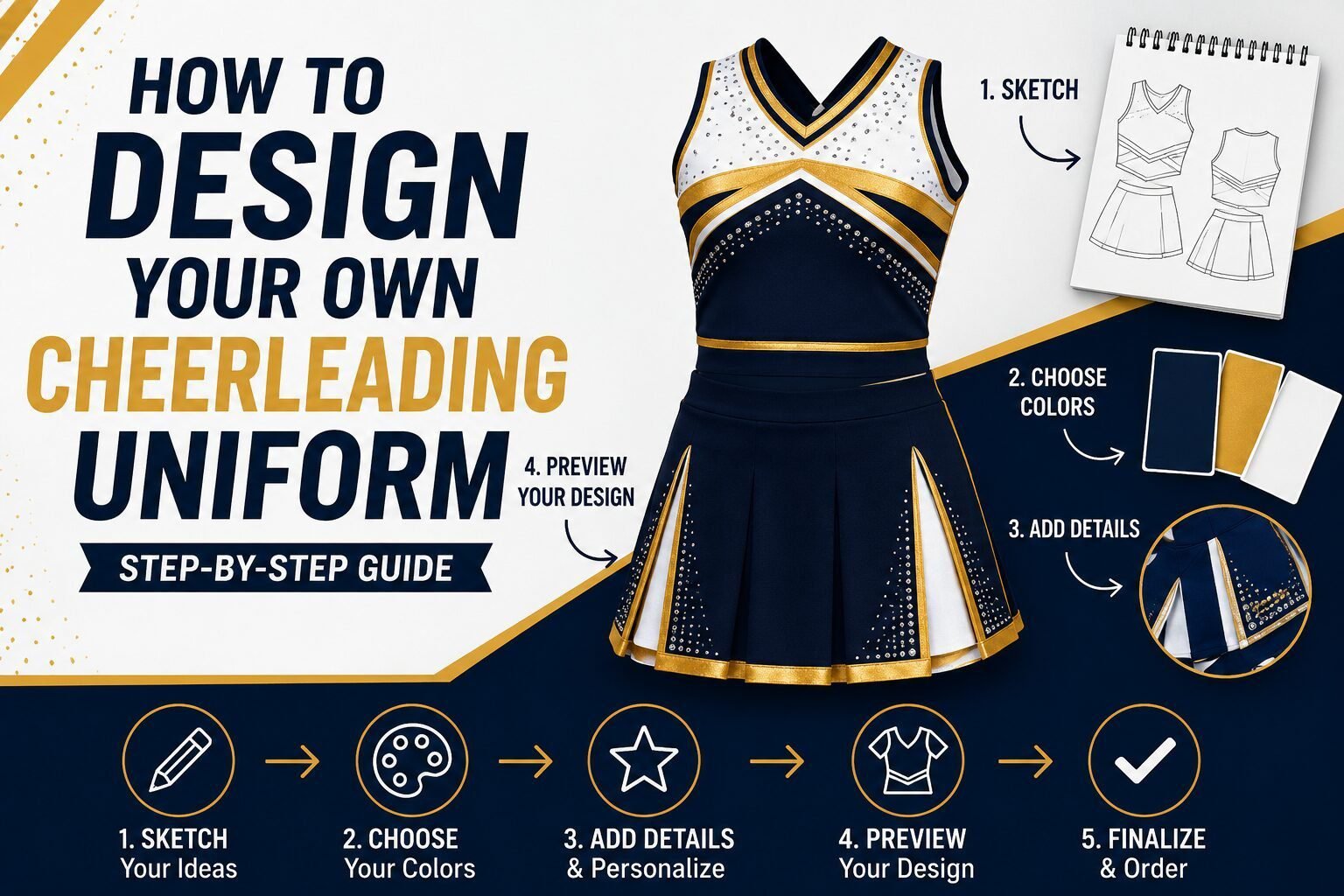
Designing your own cheerleading uniform sounds simple until you actually sit down to do it — then you’re suddenly deciding between three skirt styles, five accent colors, and a logo file that turns out to be the wrong format. It’s one of the most exciting parts of a new season, but it’s also where most teams either overspend, miss league rules, or end up with a uniform nobody’s excited to wear.
This guide walks through the exact process we use with teams at Stedge Sports when they come to us to design custom cheerleading uniforms — from the very first decision (before you even think about rhinestones) to the final approval before production starts.
Step 1: Start With a Design Brief, Not a Sketch
Before touching colors or fabric, get clear on the basics. Every good uniform design starts here, not with Pinterest boards.
- Team name and mascot — these often decide where logos and accents naturally sit on the uniform
- Official team colors — pick one primary color and no more than 1–2 accent colors; too many colors dilute the whole design instead of strengthening it
- What the uniform is actually for — sideline uniforms and competition uniforms are not the same thing, and mixing up the requirements is one of the most common early mistakes
- The vibe you’re going for — bold and modern, or classic and traditional; most teams land somewhere in between
Step 2: Choose Your Silhouette
This is the foundation everything else builds on.
Top styles:
- Shell top — the classic, clean option most sideline squads still use
- Crop top — modern, more freedom of movement
- Long-sleeve liner — added coverage, common in colder-weather sideline seasons
- Bodysuit — increasingly common for competition teams that need one continuous line during stunts
Skirt/bottom styles:
- A-line skirt — timeless, flattering, works for almost any team
- Pleated skirt — more movement and flair during routines
- Built-in briefs — the practical choice for teams that are stunting and tumbling constantly
One-piece vs. two-piece: Two-piece sets give more flexibility to mix and rematch tops/skirts across seasons. One-piece designs look more streamlined and are increasingly popular for competition-level squads.
Step 3: Lock In Color Blocking and Trim
Your team colors are fixed — how you use them is where the design actually happens. Color blocking, piping along seams, and accent panels are what separate a flat, generic-looking uniform from one that reads well from the stands and under competition lighting. If you want a premium look, metallics or an ombré fade in the accent color can elevate a fairly simple design without adding real cost.
Step 4: Pick a Fabric That Can Handle Stunts and Tumbling
Cheer uniforms take a beating — stunts, tumbling passes, and full-out routines all put real stress on the fabric. Look for:
- Four-way stretch for full range of motion during stunts and jumps
- Moisture-wicking performance so athletes stay comfortable through a full routine
- A fabric weight that holds its shape without restricting movement
Most cheer uniform graphics — the bold color-blocked patterns, gradients, and all-over designs — are applied through sublimation printing, since it’s the only method that renders full-color, edge-to-edge designs without adding weight or stiffness to stretch fabric. If you want the full breakdown of how sublimation compares to screen printing and embroidery, we cover that in detail in our sublimation vs screen printing guide.
Step 5: Add Your Logo, Mascot, and Embellishments
Send your logo or mascot as a high-resolution vector file (AI, EPS, or SVG) — these scale to any size on the uniform without pixelating, unlike a JPEG or PNG pulled off a school website. Check orientation early too; some mascots look great stretched horizontally across a chest panel but awkward vertically on a skirt panel, or vice versa.
For embellishments, keep it simple:
- Rhinestones — the classic competition sparkle, but cost scales with density, so decide upfront how much bling the budget allows
- Sublimated graphics — best for bold patterns, gradients, and full-color logos without extra per-piece cost
- Sequins and metallic trim — good for accenting a design without covering the whole uniform
A simpler design with clean logo placement almost always looks more professional than an overcrowded one — this is true whether you’re designing for cheerleading uniforms or any other team sport.
Step 6: Check League and Competition Rules Before You Finalize Anything
This step gets skipped more often than it should, and it’s the one that causes real problems later. Every cheer organization — school leagues, All-Star competitions, professional showcases — has its own uniform rules, and violating them can mean penalties or disqualification on competition day. Before locking in your design, confirm:
- Coverage requirements (midriff exposure, skirt length, neckline)
- Any restrictions on logos, wording, or graphics
- Rules around embellishments — some competitions limit rhinestones or anything with sharp edges
Check directly with your league or governing body before finalizing, not after the uniforms arrive.
Step 7: Get Sized Right — Don’t Guess
Sizing mistakes are one of the most expensive things to fix after production. Take real measurements (bust, waist, hips) for every athlete rather than estimating off a size chart alone, and where possible, use sample sizing or a fit kit before committing to the full team order. A uniform that doesn’t fit properly doesn’t just look wrong in photos — it can genuinely affect an athlete’s performance during stunts and tumbling.
Step 8: Review the Mockup Before Production Starts
Once the design is finalized, you should get a rendered mockup showing the uniform from multiple angles before anything goes into bulk production. This is your last real chance to catch anything off — a color that doesn’t match your fabric swatch, a logo that’s sized wrong, trim that doesn’t line up the way you pictured it. Take the time here. Changes after production starts cost far more than changes before it.
Step 9: Complete the Look With Accessories
The uniform is the centerpiece, but most teams finish the look with matching bows, warm-up jackets, poms, and gear bags in the same color palette. Browse our accessories collection for pieces that round out the full team kit.
Sideline vs. Competition Uniforms: Quick Reference
| Factor | Sideline Uniform | Competition Uniform |
|---|---|---|
| Stretch needs | Moderate | High — full range of motion required |
| Embellishment level | Lighter, cleaner look | Heavier — rhinestones, metallics, more detail |
| Design flexibility | Classic, school-brand focused | Bolder, trend-driven, more personality |
| Typical use | Games, pep rallies, school events | Regional/national competitions |
How Long Does It Take?
From an approved mockup to delivery, custom cheerleading uniforms typically take 6–10 weeks to produce. If your competition date is tighter than that, ask about rush production options before you finalize the design — it’s much easier to plan for a rush order upfront than to request one halfway through production.
Common Mistakes to Avoid
- Overcomplicating the design — more colors and embellishments mean more cost and more chances for something to look off; simple, clean designs usually photograph and perform better
- Skipping the league rulebook — finding out about a coverage violation after the uniforms arrive is a costly mistake
- Guessing at sizes — always measure, never estimate
- Adding elements last-minute — budget and timelines both suffer when extras get added after the design is locked
- Approving a mockup without a close look — this is the last checkpoint before production; use it
FAQs
How much do custom cheerleading uniforms cost? Cost depends on design complexity, fabric, and embellishment level — a simpler sublimated design with light color blocking costs less than a heavily rhinestoned competition uniform. Getting an accurate quote means sending your design brief and team size to a manufacturer directly.
Can a small team afford custom uniforms? Yes. Careful budgeting, simpler designs, and avoiding last-minute additions all keep custom cheer uniforms affordable for smaller programs — you don’t need heavy embellishment to get a professional-looking result.
What’s the difference between sideline and competition cheer uniforms? Sideline uniforms prioritize a clean, school-branded look for games and events. Competition uniforms need more stretch for stunts and tumbling, and typically carry heavier embellishment like rhinestones and metallics.
Do I need a vector file for my logo? Yes, ideally. A vector file (AI, EPS, or SVG) scales to any size on the uniform without losing quality, unlike a standard JPEG or PNG.
How long does it take to get custom cheer uniforms made? Typically 6–10 weeks from mockup approval to delivery. Rush production is often available if you flag your deadline early in the design process.
Can I combine rhinestones and sublimation on one uniform? Yes — this is common for competition uniforms. Sublimation handles the bold, all-over color design, while rhinestones are added afterward as accents for extra sparkle under competition lighting.
Ready to design your team’s next cheer uniform? Browse our custom cheerleading uniforms or get a free design quote and we’ll walk you through fabric, sizing, and timeline based on your team’s needs.